

Pitchmarks #144 - “Simple Recipes”
A stroll through Swinley Forest…

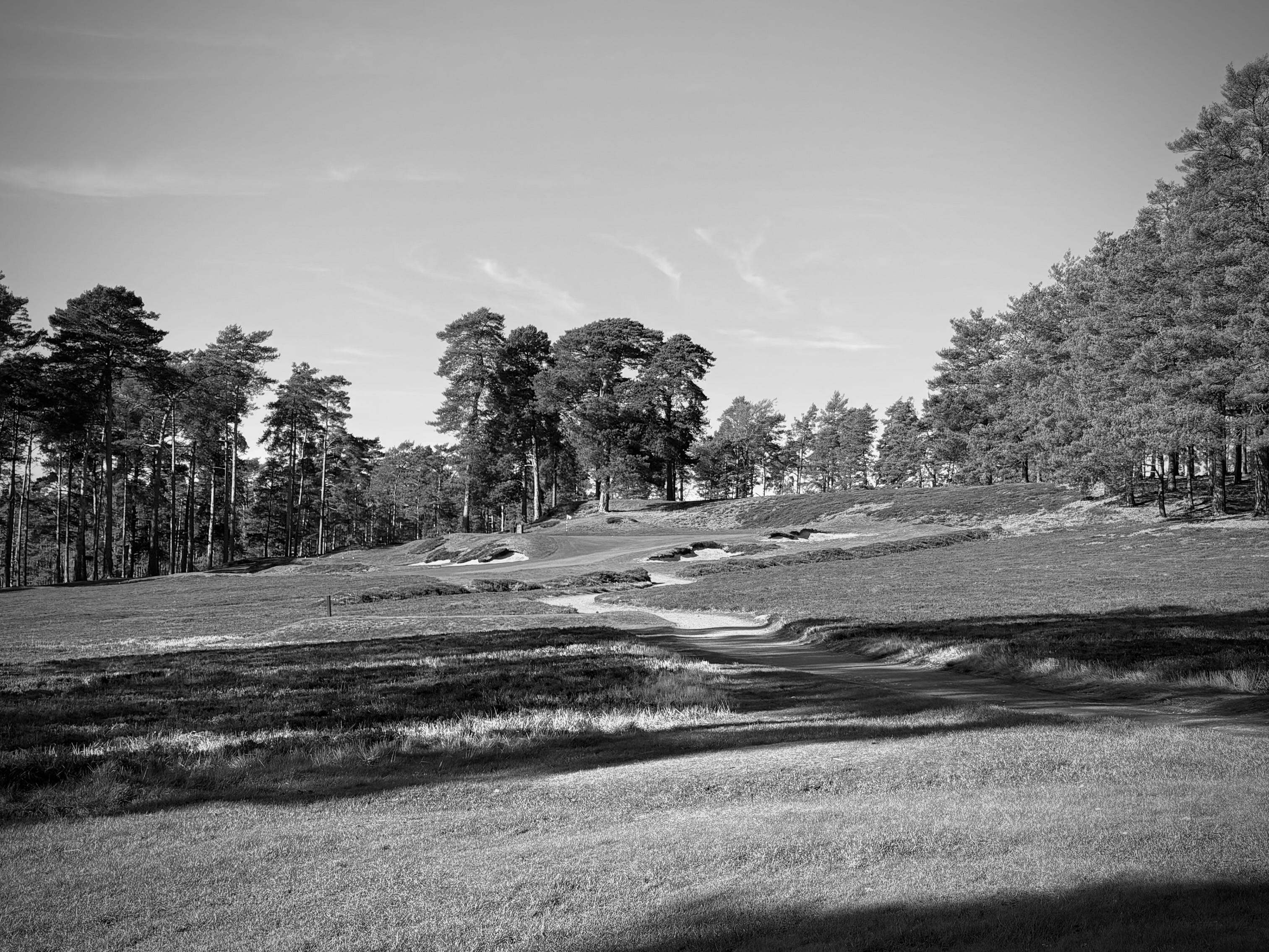
Some recipes are so wonderfully simple that they seem to shrug in the face of complexity. French vinaigrette, for example - one part vinegar to three parts oil, with just a pinch of mustard. Such a basic formula, and yet it cannot be improved upon. Or Rembrandt’s line drawings, where the economy of the reed pen or the chalk could summon the life in the subject free of colour or clutter. And one more - Bob Dylan alone with just his acoustic guitar and a heart full of folk, plucking out “Don’t Think Twice, It’s All Right”. Such things have a way of airing their very essence that requires no help along the way.
On the terrace at Swinley Forest, as shafts of the low March sun peer through the tall Scots pines, and a gentle breeze tickles the flag silks of a deserted putting green, David and I seek replenishment in the local delicacy, whose recipe remains a closely guarded secret for the loyal staff who deliver it. I must have gently enquired about the constituents of the “Swinley Special” half a dozen times by now, and have quietly retired from asking, but I suspect the truth is that it is - like the magnificent golf course that we have just once more devoured - a blend that is refreshingly straightforward. More than the sum of its parts, although the eighteen movements that make up this extraordinary whole are far from ordinary.
Harry Colt was no idle soul, his genial touch in one way or another bringing style and strategy to a few hundred tracks, and many thousands of holes. But the quote that is often mentioned in relation to this patch is that Swinley was, in his words, his “least bad course”, a humble analysis that perhaps sat as comfortably with his quiet, private character as the course does in the pristine heathland through which he guides us. That this description was found in a letter to Tom Simpson - whose own grasp of both the devastating power of the sketch and the artistry of this new profession made him one of very few who could share the sacred space with Colt - pleases me, for of all the examples I’ve seen, this one is closest to Simpson’s for a blend of brilliance and beauty.
Whether this was really his favourite, we’ll never know, for he was a man whose cards were kept close to his chest, but perhaps he recognised in Swinley an heirloom for the generations behind him that would just become more precious with time; a design that soars above convention, and rules, and par values. Next to no-one cares what the par is round here, and as far as I can work out, no-one is counting, for we are all too busy grappling with whichever of the holes that happens to be exposing us at the time. Individually, they are each so wonderfully distinct as to be worlds in themselves, or heavens perhaps, but woven together in this sandy trek through the forest they become the constituent lines of some staggering sonnet, the ingredients of another simple, perfect recipe.
I remember each hole as if they are etched on my soul, and meeting them again is an act of grateful reunion. The delightful angles of the third, when played from the left-hand side, and its crafty contours as the green bleeds away at the edges. The daunting radiance of the fourth, whose flag is always just beyond reach somehow. The mischief of the steady rise to the seventh, where a ball can fly over what looks like a greenside bunker and still finish way, way short. And from there, a spine that will calmly repel all but the perfect chip from the little, ridged plateau where the hole hides.
At the eighth, my pulse reacts to hells left, right and long, then the extravagant ninth, swinging hard left up the hill to another little pinnacle in the distance. The anti-clockwise loop from the twelfth to the fourteenth has all I will ever need from golf and more, and - though for some unfathomable reason the fabulous contours that once right-flanked the short seventeenth were softened some years ago - the diluted and damaged edition we play today is still worthy of any other golf course, Colt’s or otherwise.
In isolation, most of the holes would not seem out of place on one of his more flamboyant, decorated courses, but glued together like this, I wonder if even the heroic Pine Valley or the rhythmic Muirfield could pretend to be more coherent or more natural than this. Within a few miles are more gems from the same hand - St George’s Hill, at the beginning of what will be a marvellous, restorative revival, and Sunningdale’s New an even closer cousin about to go under a different knife. But while their splendour has been tinkered with over time, and some of what he built at Wentworth compromised, maybe his “least bad course” has become all the more precious to the rest of us because so little has changed here.
Dylan’s original recording can’t be touched, of course, only covered, and even the less heralded Rembrandts are protected by glass and thick ropes. It seems to me that the recipe for this special place is easier to calculate than that of the beverage over which we consider it. Swinley has been blessed with fine, free-draining soil, and a fabulous, rolling piece of land. Add way more than a pinch of great architecture from one of this planet’s gods, and you have a concoction with more charm and character than many of its famous neighbours could dream of. And the final piece of this delectable jigsaw lies in a scarcity of interference, for it has been largely untouched, and that is how it should stay.
If this is how Colt wanted it, nothing on earth should change that. It is astonishing…
Fabulous writing as always Richard. Brought me back to the couple of rounds I’ve had at SF over the years. Melbourne and the sandbelt is waiting for you - when do we see you here ? 🏌️♂️
This brought me back to a wonderful fall day spent at Swinley with one of my closest golfing mates. Thank you Richard.