

Pitchmarks #165 - "On Coll Time"

There is a passage in my beloved 1974 copy of Robert Pirsig’s Zen and the Art of Motorcycle Maintenance that changes me every single time I read it. A father and son on a motorcycle trip fill up at a gas station in some forgotten town off the beaten track, and engage in a leisurely conversation with two locals. Something does not quite seem right, and then the father—effectively the author, Robert Pirsig—realises what is different. It is that the two gentlemen with whom their delightful conversation is conducted are in no hurry, and that this state is so rare that it feels strange.
Five decades and a whole lot of hurry later, an idea germinates from two spots on either side of the Atlantic Ocean, culminating in a plan that is to take place on a tiny island that sits very much on my side of that vast body of water. Many messages are sent and read, calls made, logistics considered. Ferries are booked, and long- range weather forecasts pored over, in order to determine whether ferries might actually run.
My front door clicks shut with the moon high and dominant in the sky, and I drive almost without pause to Silloth-on-Solway, where I will spend three blissful hours stretching my legs ahead of the final section up to Oban. A few minutes ahead of me on the winding roads of the west highlands, no doubt trying as hard as I am to see clearly as the light fades and heavy rain batters Scotland, is Pam. She has peeled away from a damp tent at Royal Troon, where the latest Open Championship is being fought, but neither of us will catch the Claret Jug being lifted in person or on a screen, for we will spend the intervening days in the study of a version of golf that is poles apart from the professional game. We are heading to Coll.
Pam is an enthusiastic and well-organised golfing traveller, and despite her concerns over parking and the short commute to the terminal, we manage it, largely thanks to her. I stop on the hill above Oban a little before 11pm, pulling the van into what appears to be a cemetery car park, and wake about five hours later to the ambient soundtrack of the whole journey this far—driving rain. Down in the town, Pam checks into and out of a B&B without ever seeing the sleeping owner, and before long we are on deck as the iconic CalMac craft leaves port heading for the Inner Hebrides.
A few people raise eyebrows at our golf bags, and the one or two who stop to quiz us assume that we will be playing on Tiree, where the golf course is well-known. But these last few weeks have been spent looking forward to arriving at a different track on Coll—a nine-holer that hibernates from season to season, only flowering in the early part of the summer, each year since 1975. And therein lies the hook that had us scrambling for ferry spaces and car parks. For the golfers on Coll build their links afresh each year.
We peer at the Tiree course through binoculars, but on approach to Arinagour, we cannot see the fluttering flags upon Coll, for they lie over the brow of a central ridge that spans the island. But we do spot what is almost certainly Campbell, who is at the front of the line of those waiting on the rampart to greet passengers—the golfing waterproof gives that away. It is a wonderfully warm welcome, and we are delighted to then meet Margaret, Campbell’s “better half ”, and their friends David & Anne. That all four came down to see us arrive seems slightly over the top, but as time goes on, we come to realise how important the ferry is to these island people, and how their days are metered out by certain fixed points, in between which lie these acres of freedom.
Over the first bout of an extraordinary streak of hot tea and homemade cakes, Margaret—who was born here and lived in this very fisherman’s cottage for the first sixteen years of her life before heading away to Glasgow—explains the fine art of shopping on Coll. There are a couple of local stores, and they are well supported, but certain items are easier to obtain when an islander has reason to pop over to the mainland. But if you tell anyone you are heading for Oban or beyond, news spreads like wildfire through the community, and you head off with a handful of shopping lists, and return with stuffed bags of produce for your neighbours. Margaret tries to pretend that she and Campbell keep quiet in such circumstances, but you can tell that they look out for each other, the Coll inhabitants, and these two have been doing so, and returning for long swathes of time to Margaret’s parents’ old terraced cottage, for longer than they care to calculate just now.
A discernible lull in the rain on the windows has me gazing out at the bobbing fishing boats, and Campbell quickly detects that I am keen to stretch my legs. So Pam and I chuck on our own waterproofs, and he drives us up into the centre of Coll, through farmland and past an occasional ruin, each of which makes me glad that I am so lousy at DIY, for they might otherwise tempt me as “projects”. His driving is cautious, given that you can see for hundreds of yards ahead, but then it occurs to me that this unhurriedness is a great part of the charm of such places, and that I am yet to settle into that comforting rhythm.
Near the fork in the road at Arnabost, where we shall veer left towards Grishipoll, another vehicle comes into view, and this sense of leisure, and perhaps respect, is further enforced. Campbell and the driver talk for several minutes, and nothing in their conversation ever feels forced, or an intrusion. Instead, it is just that same cadence Pirsig observed...simple, human interaction without the sense of the clock ticking for some state other than just this. I notice and try to release my ow impatience to set eyes on the course that Campbell has once again helped shape, for this is Scotland in June, and though the skies will be pitch black and riddled with stars by nightfall, there are still hours upon hours of the light ahead.
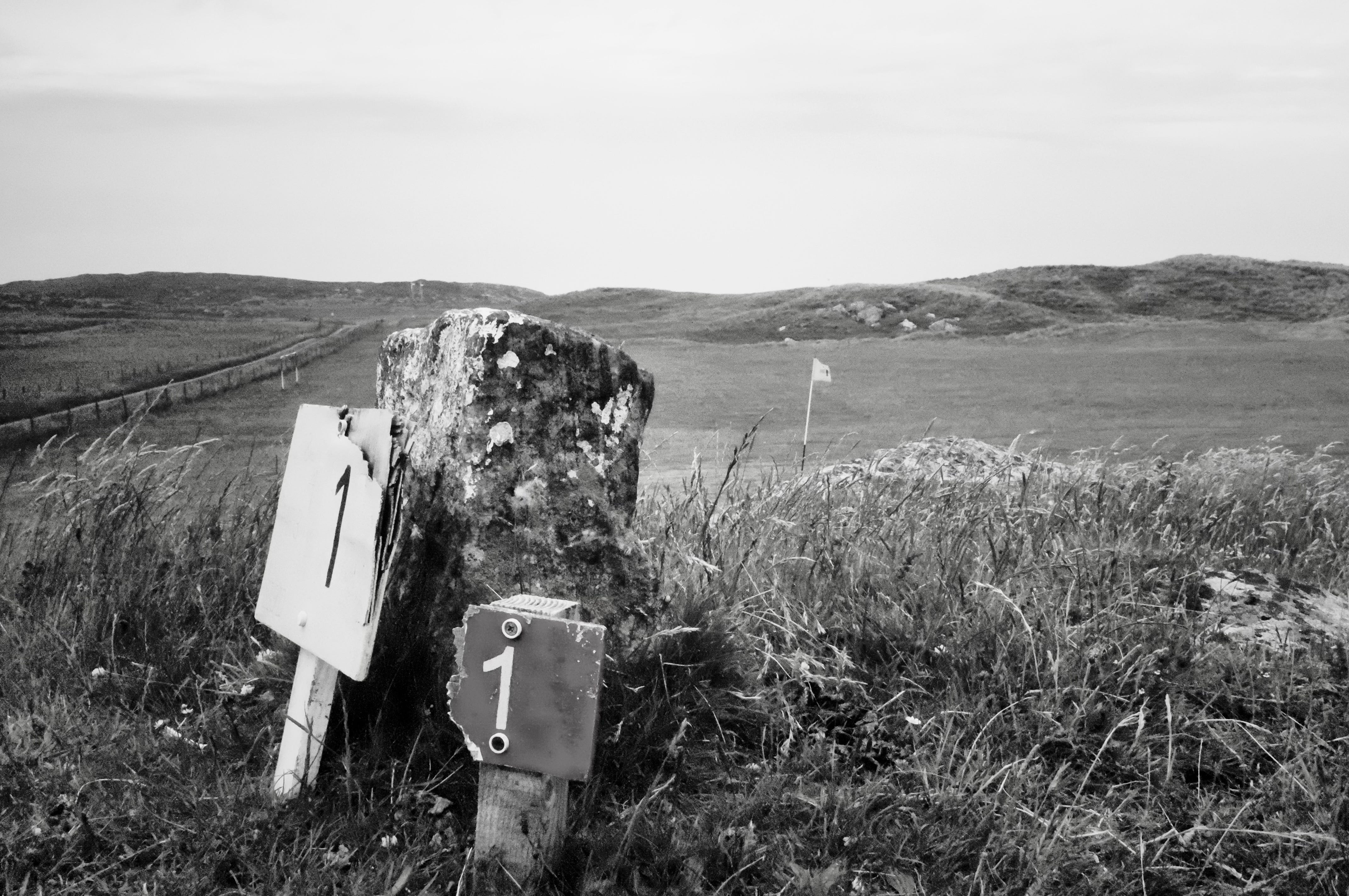
Eventually, their chat peters out, and motion resumes. A smart, metal gate sits on the right of the road, and I jump out at Campbell’s request to unloop the old rope that tethers it closed, keeping the sheep within the confines of Cliad Farm, on whose land the course lies. We unload our clubs and Campbell points us in the right direction, starting from a tiny platform to head down the hill for the first. He will not play this afternoon, complaining of a pain in his side, but he is pleased to see us strike off, and it is hard to mask the joy of my initial glimpse of the course. Everything here suits my eye—the rustic, weather-worn markers on the tees, the simple but carefully mown lines. The pitch-and-putt on which I grew up was often very tatty, but in those unraked bunkers and well-worn greens the spirit of the game, of “playing it as it lies” was present, and it occurs to me that nowhere since have I quite found that stylistic sweet spot again. But Coll was hewn from the same cloth, and it was love at first sight.
We cross a stile to play the second from the other side of the deserted road, before the third takes us down to an impossibly wonderful brook at the far end of the routing, the green perched just this side of it. Once upon a time, the golf went beyond this point, up into Cliad’s hillier terrain, but at some point, due to the complications of the livestock and other demands on the land, the fourth was altered to come back up the hill. If the first three were charming, the fourth is where Coll digs its heels in, for the second shot must carry a deep ridge thick with long grasses. Gauging the distance is a matter of judgment, and over multiple plays neither Pam or I manage this correctly, and I wonder whether Campbell and his friends ever do.
The fifth is played over the brow of a mown hill, and it is equally perplexing, if a little less dangerous. All around are the most wonderful, delicate wildflowers, and if another golf course ever felt this natural, I am yet to see it. From the sixth tee, you play down towards the rusting frame of a football goal, and from there swing slightly left to another tricky target. In some strange way, the seventh reminds me of the Road Hole in the way that the existing features of the landscape are utilised to play around. The drive must be carefully placed to the right of the corner of Coll’s tip, for the fencing that protects that area is as fierce as the green that awaits beyond. It is golf that you have to think about, and that it uses a less-than-desirable factor as such a brilliant hazard delights me.
From there, one walks a little further right to play the eighth tee shot back into that field, from where my favourite shot on the course is demanded. The green is perched up a steep, mown slope, so that you either have to fly the ball up there in such a way as it stops, or take your chances running one in. It is an exquisite piece of design, and that Coll has been put together by voluntary enthusiasts over a few decades, and mown out more or less to the previous year’s design each May seems to mock the seriousness of the modern game on the mainland. The eighth defeats us, of course, and we stroll around the base of the granite lump that dominates this top end of the course to find the short ninth, a gorgeous pitch up the hill.
Though time is slowly falling away as a concept, we have agreed when Campbell will swing by to pick us up, and are delighted to find that we have leeway to flit round again. This time certain holes seem easier, but we suffer in different places, and my face aches from grinning by the point we hear the gate swing open again. On the way home, I sit in the back, not so much lost in thought as lost in feeling. I had arrived here from a busy spell, paddling like fury beneath the surface to just about stay afloat, but never quite on top of things—the logistics of this trip included. But in the space of an hour and a half, and probably eighty swipes at a succession of old balls, I felt as if the gentle breeze across Coll had not only wiped that hurried slate of the past month or so clean, but perhaps that of a few decades.
This was the golf I played over Heath Park, come rain or shine, from dawn through to dusk some days. Some flags in a field, a little gentle maintenance, a club and a ball and my imagination for company. Who could possibly care if the bunkers were not raked when there was simple adventure like this to be had? And yet, I had fallen away from the spell of this habit, from the healing power of play. To follow the herd, to play by the rules. There is some vague sense of yearning that lurks in me for that boy, clipping wedges round the park for all eternity, or so it then seemed. And now, on the cusp of fifty, turning grey and pining for a state I think I may never know again... until I find Coll. And only then do I understand why I came.
Margaret is waiting for us when we return, and insists that we dine up at the hotel, where Pam is staying. We tidy ourselves up as much as possible from a small bag of luggage, and delight in the chance to learn more about this lovely couple and their lives on and off this magical island, but not before a pre-lunch refreshment in their “Sitooterie”. Sitting sideways on, across the road that runs through Arinagour, this lovingly maintained shed is the hub of their social lives. Neighbours and friends from all over Coll will descend, often unannounced, for some tea or something “a wee bit stronger”, and Campbell will fold open the doors and pull some chairs onto the slatted deck, from where the ferries and fishing boats and this blessed ocean view can be gently absorbed, like medicine for the soul.
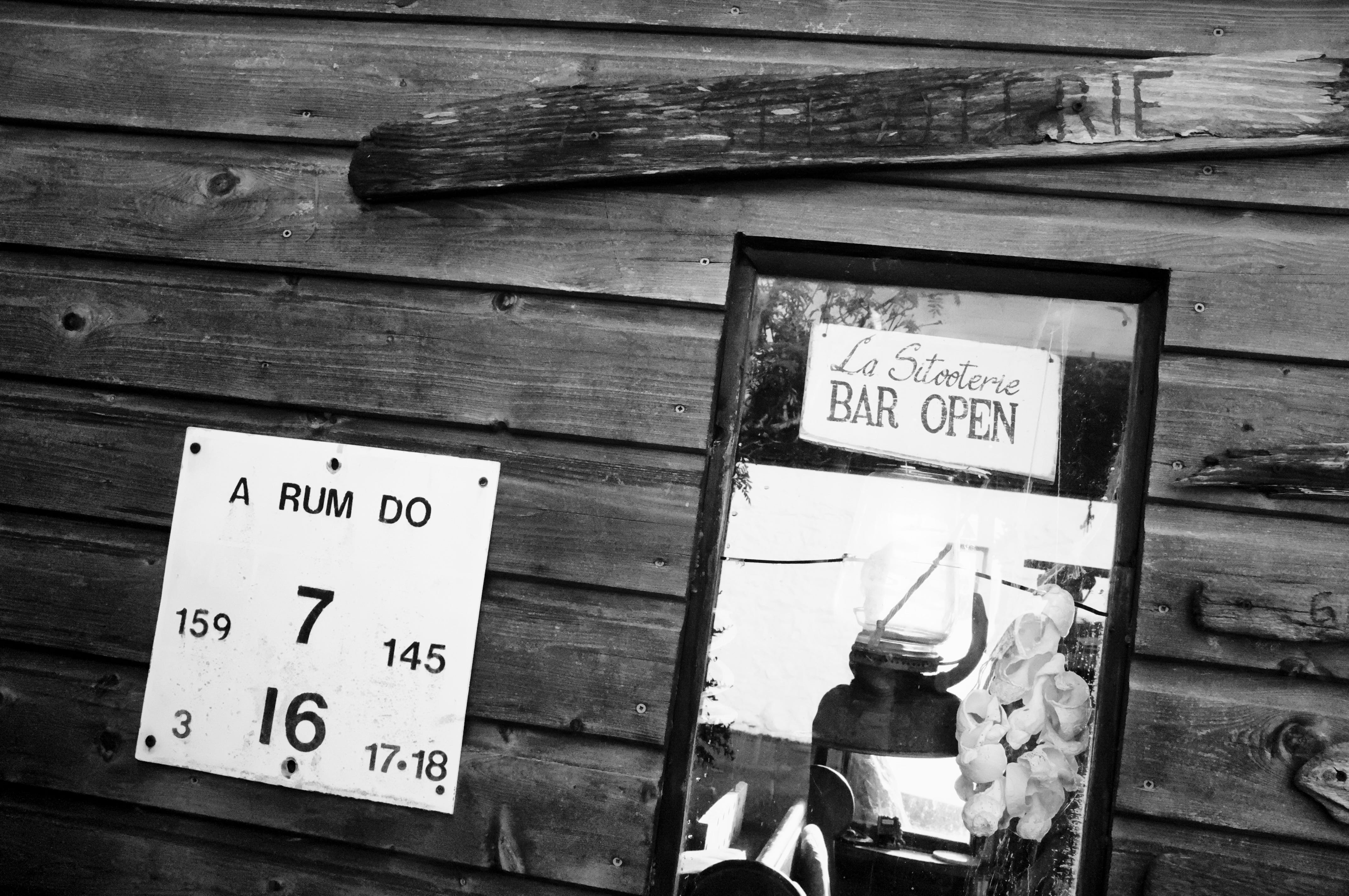
And it occurs to me that perhaps time is not simply passing slowly here, it is passing by altogether. As in not stopping, not mattering. The people are not obsessed by the past or anxious about the future, for they are immersed in the present, like the sheep that wander past the Sitooterie and the herring gulls that circle around the trawler. And by living this way, they wear a sincerity that feels such a gift to bestow. The Coll community, both permanent and interim, are just that—a community, connected deeply to one another, and to today, and to this beautiful, isolated place.
Dinner is wonderful, and we find sitting on the hotel bar the repurposed Scotch bottle that serves as the green fee register and the membership database for Coll’s golf course, reconciled each season by Campbell’s great golfing friend David Moore, Jr and his wife Margaret. Davie and Campbell have battled out a thousand duels over the Coll links since its inception, and he suggests we head over in the morning to meet them. And we try to fix a time, but that is not really how things work here, so we settle on “around nine”, and delight when our acceptance of this vagueness is recognised, for it means we are “on Coll Time now”. Coll Time is only ever approximate, even in the case of the ferry, for things change, and the islanders are not willing to worry about things beyond their control.
The Moores live a good chunk of the year in a static caravan (the sign on which says, simply, “Moorefield”, in tribute to the great East Lothian links) out towards Cornaig Bay, at the north-west corner of the island. Davie’s father had come out here for a holiday in 1975, and quickly discovered that he “couldn’t exist without golf ”. So the Coll course was carved out that summer, but Davie waves a hand out the window as the kettle whistles behind him, and casually mentions the six holes that were also “out there”, on the gentle slopes down towards some unnamed and idyllic sandy bay.
Pam and I want to drag Davie out into the drizzle to show us where these holes were, but we are all too busy enjoying the stories of these two pioneers of golf on Coll, and as they exchange tales like blows in the lifelong match they’ve fought, I flick through a near-complete folder of Coll Magazine, which features each summer a report on the golf course and their Open, which at its peak around the early nineties had up to twenty players. At first, it was played with only three or four clubs, though neither veteran can remember which number it was, but the details do not matter to me for it is all about the spirit, and I cherish this time in the caravan with these four locals, pouring out their love for this remote spot and its people.
We finally drag ourselves away, in order that Davie can finish the maintenance job we interrupted some time before, and though Campbell does not like the look of the cloud lingering above the waves out west, he is willing to drop us once again inside the gate, in order that we can digest all that we have seen over a few holes. His final warning is that “you’ll be wet within the hour”, and though by now we have ditched all time-pieces, we are on our second failed attempt at the fourth when the heavens open, and we conclude that Campbell can actually smell impending rain, so in tune with this environment is he.
We shake hands once more, and stand looking back over the ridges and hollows, the waving grasses and the sodden, bright yellow flags, and I feel a pang of sadness to leave Coll behind, as we will in the morning. On the way down to the boat terminal, we notice once more the stranded cars by the road, and the friendly waves of the people we pass, and try to imprint something of this unhurriedness, this supportiveness on ourselves before the boat casts off. For this is a real community, where people look out for each other, and care about each other, and that is the common string that makes it all work, that makes living out here—where nothing much is convenient or fast—not only possible but wonderful.
We go through the motions of the ferry in reverse, as if caught in some vintage movie, and wave for what seems like forever at David and Anne, and Campbell and Margaret, and we all carry on flapping until we can barely make out faces. And Pam and I make for the coffee bar, and offload our reflections and photos, and slowly inch our way towards the world that awaits us on the mainland. And I like to think our hosts made the short drive up to the house, and carefully flicked on the kettle, grateful once more for the electricity that Campbell helped install in that ancient family dwelling, and then to the Sitooterie, for not only is there not a great deal else to do on Coll, but nor is there anything much better to do anywhere.
The weeks turn into months, and as I sit here thinking about those few days out on Coll, they seem a thousand years away. The impatience that I carry sometimes is like a psychic inheritance to some degree; I recall traces of it in my father before me. But what is all this impatience for? For something other than this? Some time other than now? There’s nowhere else to go. Above my desk I keep an image of the red marker beside the sixth tee at Coll. And every time I look at it I. yearn to feel that light—or sometimes heavy—rain on my skin, and the breeze in my hair, and that turf beneath my feet. And I yearn to live like they do, with trust in each other and ourselves. Rooted in the present moment, and how things are, rather than how they might be.
For you could change the golf at Coll - make it shinier and neater, perhaps - but I think that to do so would be a betrayal of something very special. It would show a dis- satisfaction with the natural order of things, and as far as I can see, as I watch the raindrops on the grasses of that photo blur as teardrops form in my own eyes, there is nothing any of us could do that would make it better. It exists in its own dimension, between June and August, for about fifty years by now. And it runs on Coll Time.